
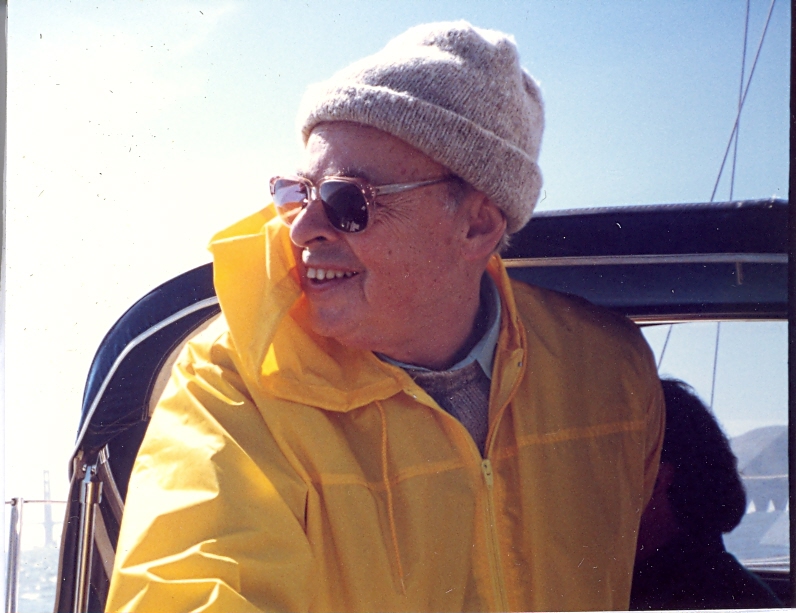
Walter Glass of Sleepy Hollow, New York, died in his sleep early in the morning of April 15, 2012, at Kendal-on- Hudson, a continuing care community affiliated with the Quakers, where he had lived since 2005. He was 91.
Walter was born Walter Heinz Frauenglas in Vienna, Austria, the second child of Leo Frauenglas and Ida Hess. His father was a small merchant, his mother a housewife; his sister, twelve years older, was an opera singer. As a boy Walter was interested in international affairs and had read Mein Kampf. He held no illusions about what Hitler’s rise portended for European Jews. However, he could not persuade his family of the danger, and was forced to flee alone.
After being sent back to Vienna from France on his first attempt, he managed to escape Austria and Europe, sailing for New York on the Acquitania in February 1939. There he was taken in by his relatives, Louis and Lillian Frauenglass, a childless couple. He found work that summer as a floor boy pushing clothing racks at S. Klein on Union Square in Manhattan. Lou and Lilly urged him to live with them as a son and work in the garment business, but Walter was set on higher education. On his departure from New York to Texas for college in September 1939 he adopted the name Walter Henry Glass, which became his legal name upon his naturalization in 1943. His last communication from his parents was a letter dated January 20, 1940, and he never heard from them again. When efforts to find them after the war proved fruitless, he assumed they had perished in the Holocaust. A son-in-law later found records that they had been shipped by train from Vienna to Lodz, Poland. There the trace was lost.
Walter graduated Phi Beta Kappa and summa cum laude from the University of Texas at Austin, completing his course work in three years and obtaining admission to Harvard Law School, where he enrolled in 1942. His legal education was interrupted by two years of military service in the U.S. and Europe, where he was a technician in the U.S. Army Psychological Warfare Branch (Signal Corps). He trained for this work at Camp Ritchie, the subject of the documentary film “The Ritchie Boys,” about the exploits of German-speaking Jewish immigrants in the U.S. Army, stateside and at the front. In Europe a fellow soldier patiently taught him to drive their truck. (He later copied his friend’s method to successfully teach each of his four children to drive stick-shift automobiles.)
Upon graduation in 1947 he worked at the Securities and Exchange Commission, first in Philadelphia and then in Washington, DC. In Washington he met his future wife, Ann Murkland, and they were married in April 1949. Elliott Richardson, a Harvard classmate, acted as best man.
From 1950 to 1952 he worked for the tripartite High Command for Occupied Germany on reorganization plans for the German coal industry as part of the formation of the European Coal and Steel Community, where his legal skills and native fluency in German were at a premium. A daughter, Martha, was born in Essen, Germany in 1951.
In 1953 he commenced his long career at General Electric, working at the company’s offices in Schenectady, New York. His efforts for the General Electric Theater television program led to meetings with a talented Californian hosting the show –Ronald Reagan –whom he recalled as impressively professional and easy to deal with. Other than a five-year stint with Raytheon near Boston from 1959 to 1963, he would continue to work for GE in various locations until his retirement in 1986—principally as an international lawyer.
Walter’s Austrian family had not been particularly religious. His personal interest in religion developed as his four children came along. While trying to get out of Vienna, Walter had met with “Quaker ladies” stationed there. Though they could not expedite his departure, their message of hope and caring led him to keep trying to escape. Walter and Ann joined the Society of Friends (Quakers) in 1953 and found spiritual nourishment as well as close friends there.
In an application for a security clearance prepared in 1976, Walter listed his foreign business travel: over 75 trips to Paris (he was fluent in French), Rome, London, Madrid, Tokyo, Denmark, Moscow, New Delhi, Istanbul, Caracas, Mexico City and other destinations, between 1959 and 1976. He relished the excitement of travel and the high stakes of international negotiation. His work in international law had great personal meaning. He had resisted the urgings of a famous mathematician, R. L. Moore, to make a career in mathematics, because he believed the key to avoiding another Holocaust lay in economic prosperity and in international links through trade. His work for Raytheon and GE allowed him to participate directly in building those links, a personal response to the historic tragedy that had shaped his life.
Despite the loss of his parents and beloved older sister Marthe (and her small child) to the Holocaust, Walter was an optimist with great faith in humanity. Whatever was his was, for him, the best – the best wife, the best family, the best car, boat, in-laws, grandchildren. He was an affectionate and very attentive husband, father and grandfather. He gave a daughter this simple philosophy: “Work hard and be nice to people.” He was not embittered by his experience, but knew that he could never take the right to life or happiness for granted or as guaranteed.
As a young lawyer he learned to sail on weekend voyages out of Rhode Island with a senior colleague who was prepping for a trans-Atlantic crossing. Sailing became a lifelong passion. He cruised the coast of Maine and the Elizabeth Islands in New England with his young family; he was farsighted and could always pick out a distant buoy before anyone else. He sailed his Sunfish out of Nichols Yacht Yard in Mamaroneck, New York, alone or with a child, and kept a 19-foot Cape Dory Typhoon in Westport, Connecticut for day-sailing in later years. The Cape Dory was called “Ergo”—because “the air makes it go.” I sail, therefore I am.
Perhaps unusually for a Quaker, he was an excellent shot, and proud of his accuracy with a pistol. But what he happily shot after his Army training years were photographs of his family and of Ann’s quilts and gardens, of which he was extremely proud. In Rowayton, Walter worked tirelessly for the Preserve the Wetlands association. He delighted his entourage with his playful, self-deprecating sense of humor. As a young man, Walter played the piano beautifully and never lost his deep love for the works of Chopin and Brahms.
Walter is survived by his wife, Ann Murkland Glass, 87, of Sleepy Hollow, New York; four children, Martha Sullivan of New York, New York; Elizabeth Poyet of Larchmont, New York; Adam Glass of Washington, D.C.; Daniel Glass of Fairfield, Connecticut; and eight grandchildren. In lieu of flowers, gifts in memory may be made to the Walter H. Glass Endowment, Harvard University, Attn: Ann Funderburk, 124 Mt. Auburn St., Cambridge MA 02138, checks payable to President and Fellows of Harvard College. It was Walter’s wish to aid immigrant students facing financial hardship, inspired by the help he received.